Featured Post Today
print this page
Latest Post
Showing posts with label 3G. Show all posts

News Update New Handset Launched : Karbonn Alfa 112, Alfa A91 Power, Alfa A93 Pop, And Titanium S205 Plus Launched

Karbonn on Wednesday launched a range of new smartphones and feature phones in the market as a part of its festive offer. The company has introduced four new smartphones namely Karbonn Alfa 112, Alfa A91 Power, Alfa A93 Pop, and Titanium S205 Plus alongside two feature handsets - K18 Jumbo and M105.
The Android-based Karbonn Alfa 112, Alfa A91 Power, Alfa A93 Pop and Titanium S205 Plus are priced at Rs. 2,890, Rs 3,290, Rs. 3,490 and Rs. 6,790, respectively. The K18 Jumbo and M105 cost Rs. 990 and Rs. 940 respectively. The company said it would also be offering special festive season discounts of up to 50 percent on Titanium Mach Five, Titanium Mach Two and Titanium S201 via e-commerce websites.
The dual-SIM (WCDMA+GSM) supporting Karbonn Titanium S205 Plus (seen above) runs Android 5.1 Lollipop out-of-the-box and features a 5-inch HD (720x1280 pixels) resolution IPS display with Dragon Trail Glass protection. It is powered by an unspecified dual-core SoC clocked at 1.2GHz and clubbed with 2GB RAM. It also houses 16GB of inbuilt storage, which can be further expanded via MicroSD card (up to 32GB). In the camera section, the Titanium S205 Plus sports an 8-megapixel autofocus rear camera with dual LED flash and a 3.2-megapixel front-facing camera as well. The smartphone supports 3G, Wi-Fi 802.11 b/g/n, Bluetooth, GPS and Micro-USB connectivity features alongside proximity sensor, G-Sensor and comes backed by a 2200mAh Li-Po battery.
The Android 5.1 Lollipop-based dual-SIM (WCDMA+GSM) Karbonn Alfa A93 Pop (seen above) features a 4.5-inch FWVGA (480x854 pixels) resolution display; 512MB RAM; 8GB inbuilt storage, which can be further expanded via MicroSD card (up to 32GB); a 2-megapixel rear camera; a 0.3-megapixel front-facing camera, and a 1400mAh battery. Connectivity features and processor remains the same as Titanium S205 Plus.
The dual-SIM (WCDMA +GSM) Karbonn Alfa A91 Power (seen above) runs the older Android 4.4 KitKat out-of-the-box and features a 4-inch WVGA (800x480 pixels) resolution display; unspecified 1GHz processor; 256MB RAM; 512MB inbuilt storage, expandable via microSD card (up to 32GB), and Li-ion 2000mAh battery. The connectivity options and camera setup stay the same as Karbonn Alfa A93 Pop mentioned above.

The Android 4.2 Jelly Bean-running dual-SIM (GSM+GSM) Karbonn Alfa 112 (seen above) features almost the same specifications as the aforementioned Karbonn Alfa A91 Power but misses out on 3G connectivity and is backed by a Li-ion 1300mAh battery.

The dual-SIM (GSM+GSM) Karbonn K18 Jumbo feature phone sports a 2.4-inch LCD display, VGA (0.3-megapixel) rear camera, FM radio, GPRS, Bluetooth and is backed by a 1800mAh battery. The dual-SIM Karbonn K-Touch M105 sports a smaller 1.8-inch LCD display, digital rear camera and 800mAh battery with rest of the specifications same as the K18 Jumbo.

News OnePlus 2 Update : OnePlus 2 (64GB) Review

Our Verdict :
While the OnePlus 2 beats everything in its price bracket, it isn't the out and out flagship killer like its predecessor. There are no heating issues, and the phone does a good job in most areas. If you're buying a new phone, this would be a good choice, but if you currently own a OnePlus One, stick to it.

About a year ago, when I first got my hands on the OnePlus One, the smartphone market was undergoing a sea change. Today, we’re accustomed to it, to the point where we expect it. In fact, the incremental updates that we get today are even boring at times, and coming from a geek, that's saying something. So, when the OnePlus 2 was handed to me, it came as no surprise, despite all the consumer interest around it.

From 29th to 10th, it's been about two weeks now, and the OnePlus 2 has been my daily driver all this time. But before I get on with the OnePlus 2 review, there are a few things that need to be mentioned. Take it like a key to reading this review, just like pointers to recognise stuff on a map.

First, I came into this review with a huge prejudice against the Snapdragon 810, having seen it first hand in the Xperia Z3 Plus. Second, I personally do not like big phones, unless they're built like the LG G3 (I still treasure the size my first gen Moto X comes in). Third, I'd pick battery life over thinness any day. Lastly, no matter what impression you get from this review, you should, under no circumstance abandon your OnePlus One for the OnePlus 2. The OnePlus 2 is an incremental update like so many other phones today, and doesn't really qualify as an update to the amazing phone that the OnePlus One was.

You still with me? Well, then here's my review of the OnePlus 2...

Build & Design :
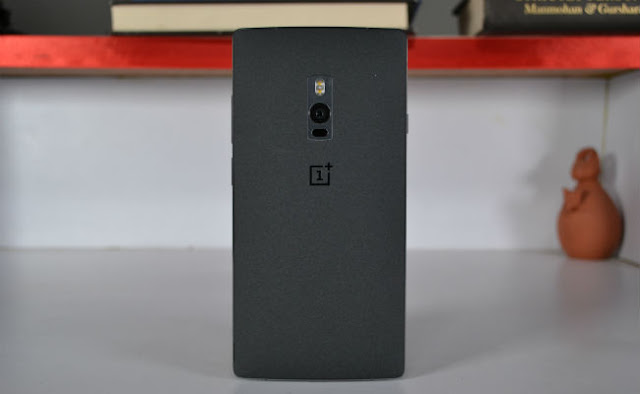
The Sandstone back remains, but it's on a thin plastic plate this time.

The build and design of the OnePlus 2 is the embodiment of the fact that it's an incremental update. The Sandstone back looks the same as in the One, but feels to be of somewhat lower quality. In giving the phone a removable back, OnePlus has had to make this onto a thin plastic plate, as opposed to the hard and full Sandstone finish on the OnePlus One. By lower quality, what I essentially mean is that the finish feels rougher on the OnePlus 2. 
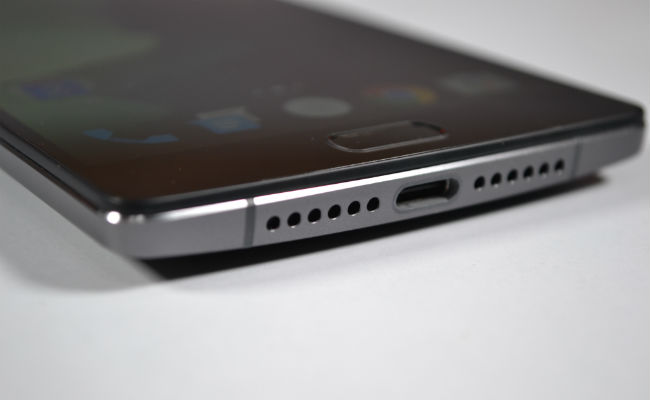
The USB Type-C port ensures that you have to carry your charger around all the time. Good that phones are adopting the new standard though.

It feels good though, and I daresay different. Carrying the OnePlus 2 around, I always felt the bulk and heft of the device, and what's surprising is that I liked it. It reminds me a lot of the Moto Turbo, even though it isn't as thick or heavy, or even as easy to use. The phone isn't really light, but it isn't heavy enough to dislike. 
The 13MP camera on the back has a laser assisted auto-focus system this time.

To all this, OnePlus has added a metal frame. There are two reasons for this — the first, to cover the 'metal build' required of ‘premium phones today, and second, to make the back removable, which it needs in order to make the styleswap covers usable. It doesn't really add anything to the overall look and feel of the phone. In fact, I find it to be a mismatch with the company's new wood finish Styleswap covers. 
The fingerprint sensor can do more than just recognise fingerprints.

Like I said before, I personally dislike big phones, but not once over the two weeks have I grimaced over the size of the OnePlus 2. It slipped into my pocket just fine and it never felt imposing or unnecessary.

Display & UI :

Perhaps the one aspect of the OnePlus 2 that I disliked is its display. The 5.5 inch FHD display is sharp enough, but it's dim, not something I like from my flagship killers. What I dislike more is how easy it is to figure out that OnePlus has cut costs here. Turn on video on the camera and move the phone around and you realise the low refresh rate of this display. Sure, I’m nitpicking, but this is a flagship killer isn’t it?

The flaws in the display are further substantiated by the UI. OxygenOS seems too much like a work in progress. My call recorder app never got up and running, while the UI had far too many other bugs as well. On no less than three occasions, I found my cellular data turned off for no reason, while the Google search bar on top of the screen would disappear at least once a day. Even the fingerprint sensor failed to recognise my print every time the phone was kept on a desk instead of my hand. The phone froze a few times due to UI glitches and the proximity sensor malfunctioned every time I took a call, resulting in some app being opened in the background whenever I got off the call, or calls being put on hold etc. without me actually doing so. It almost felt like I was using a pre-production sample or a beta product sometimes. 
 
 
These are just three examples of the buggy UI. All the icons disappear (on the left), and the Google Search bar also disappears often (on the middle), and the Notifications dropdown gets stuck (on the right).

The bugs would be irksome for a lot of basic users and even power users, but there is a kind of a statement here. OxygenOS in many ways just what I want a custom UI to be. It's not a sea change from stock Android and additions like the Shelf screen are a sign that OnePlus is developing something over the long term. It's almost an Apple-like approach, just not as polished. OxygenOS is same as Android, yet different, meaning the Shelf screen can be accommodated in the OnePlus One later, while next generations of OnePlus devices will bring new features that get added to the OnePlus 2 and so on. It would be worth mentioning that even as you read this review, OnePlus is pushing updates to the pre-sale devices that me and someof my compatriots have. 


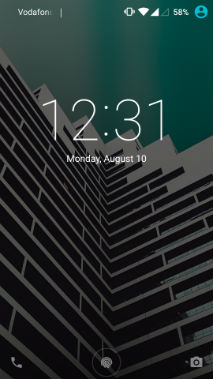
(L-R) Lock Screen, Home Screen and Shelf


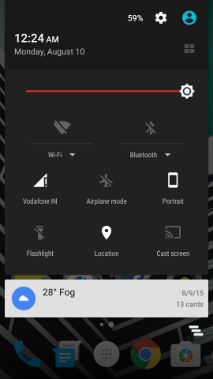
(L-R) Home Screen customisations, Multitasking screen and Quick Settings

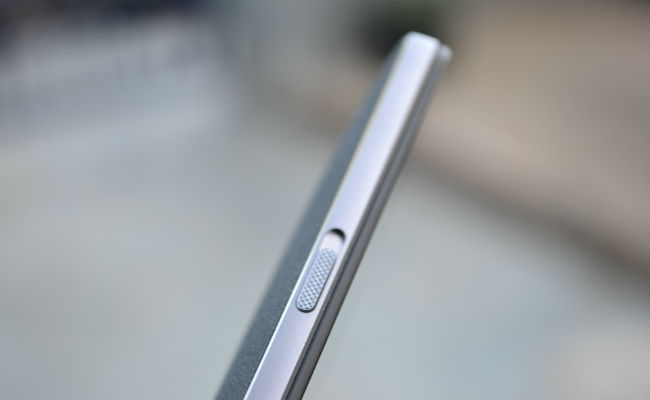
The Shelf screen, which shows my most used apps and favourite contacts, was one of two features I really used. The other one being the hardware button to switch from All Notifications to Priority and No Interruptions modes. I would have liked if OnePlus could make this button programmable for other activities as well, but this works for now. If you happen to be coming from an iPhone background, you would appreciate this button even more. 
The hardware button for toggling between various interruption modes is useful. We wish it was programmable for more though.

Fingerprint Sensor :

Faster than the Touch ID eh? Not quite. As I mentioned earlier, the fingerprint sensor would not recognise the print whenever the phone was kept on the desk. While the OnePlus 2’s fingerprint sensor is useful and can be worked with, Apple’s Touch ID is just a tad better still I think. 
While we think Apple's Touch ID is still a tad better, OnePlus' fingerprint sensor is pretty functional, except for some bugs.
Performance :

The question you should be asking here isn’t whether the OnePlus 2 heats up, but whether it heats up enough to be an issue. As I mentioned before, I was put off by the Snapdragon 810 earlier, but OnePlus has downclocked the SoC, going for almost 30% lesser performance. Delhi is one of the worst places for such an SoC though, especially during the summers.

Surprisingly though, the OnePlus 2 came out with flying colours no matter how hard I tried to get it to heat up. I’m in no way saying that the phone doesn’t heat up, it does, but it isn’t the abnormal heating that we’ve known the Snapdragon 810 for. I’ve played games like Injustice: Gods Among Us and Marvel: Contest Of Champions on this phone continuously for two hours without ever feeling any abnormal heat. It seems to be generating just the amount of heat that any SoC today would.


There are two things happening here. Firstly, the reduced clock speed of course helps. Secondly, the cooling paste that OnePlus has added allows the temperature to be reduced by 5-10% more. More importantly though, the paste cools down the SoC fast, meaning if you’re in an air conditioned room and your OnePlus 2 is a little hot, put the phone down for a minute and it will cool down. Even when I was not playing games in air conditioned room, the phone never really heated up enough for me to complain.

The reduced clock speed does hamper the phones number crunching abilities though. Hence, the benchmark scores that you see on the OnePlus 2 aren’t as groundbreaking as the OnePlus One’s. Of course, this phone surpasses its predecessor, but not by a lot. In regular usage though, the 1.7 GHz octa-core processor is everything you need and more. The OnePlus 2 runs those high end games I mentioned like a charm, and while there are some lags over extended periods of gaming, I have no complaints on the performance part.

All this is complemented by the 4GB RAM on this phone. I barely found apps being suspended, even when I opened them after a good 12 hours or so, after gaming on the phone in between.

Battery :

Along with the display, the OnePlus 2 is somewhat weak on the battery front as well. While the phone can last for a full day, you would have to try hard for it. Also, if you’re gaming a lot, then make sure the USB-Type C charger is on you at all times. With about 50% battery, the OnePlus 2 drops to 10% within an hour.

You can read about the OnePlus 2’s battery in more detail here.

Camera :

If it was about simply covering the flagship features, the OnePlus 2 does well with the ‘laser assisted auto-focus camera’. The 13MP camera on the back is also much improved as compared to the OnePlus One. It is worth mentioning though that the OnePlus 2 doesn’t focus as fast as the LG G4 though.
Gallery : 
 
In addition, OnePlus’ default app for images is Google Photos, which means every time you swipe to see an image you clicked, the phone will freeze for a second. It’s very similar to what happens on Samsung phones when you swipe across to Flipboard. Photos is not integrated into the camera app, hence, when you swipe to see the image, the screen will freeze for a few seconds before the image opens completely.

Overall, it’s a very likeable camera on the OnePlus 2. The device takes pretty nice images, and the low light performance is also quite good.

Bottomline :

If last year’s OnePlus One was a flagship killer, this is a very balanced smartphone that offers good value for your money. If you’re looking for a phone in the 20-30k price point, then I would definitely recommend a OnePlus 2, but if you’re looking to ‘upgrade’ from the OnePlus One, then you shouldn’t go for this phone.

The OnePlus 2 does everything that you need your smartphone to do, and handles every task you can throw at it. It may not be the out and out flagship killer that you expected, but it’s got the killer pricing to performance ratio still.

News OnePlus 2 Handset Update : Chinese Regulator Leaks OnePlus 2 Photos

Secret-keeping is not the technology industry's strong suit, and ahead of the July 27 launch of the OnePlus 2, images of the phone have appeared on a Chinese certification database.

As first reported by Engadget, four photos were published by TENAA, which, like the FCC, registers and certifies devices.

Based on these images, it looks like the OnePlus 2 has a physical home button—which perhaps supports a built-in fingerprint sensor—rather than the light-up icons on the OnePlus One.
A new front-facing camera, meanwhile, now resides on the opposite side of the phone's earpiece speaker. Little else seems to have changed on the facade.

Likewise, a non-descript back panel looks similar to the current model, with an ever-so-slightly lowered camera and LED housing—which features what 9to5Google identified as the new autofocus feature.

Perhaps most intriguing are the side views, which suggest the addition of a mute switch (think Apple's iPhone), or maybe a dedicated camera shutter button (think Nokia Lumia 1020), as 9to5Google speculated. The normal volume rocker and SIM-card slot are also present.

Details about the OnePlus 2 have been trickling out from the manufacturer, which recently confirmed a Qualcomm Snapdragon 810 processor and a USB-C port. But the company was waiting to release full details at a VR-inspired July 27 launch event.

Starting at 10 p.m. ET on Monday, folks around the world can stream the OnePlus 2 launch in virtual reality. Of course, you'll need a VR headset, like Google Cardboard or the sold-out OnePlus Cardboard, to watch the presentation in true form.

The Chinese smartphone maker has not yet announced exact pricing details, but earlier this month, it put to bed rumors that the next-gen handset will cost up to $200 more than its predecessor.
 
Gallery : 


News SmartPhone Update : OnePlus 2 To Have Dual-SIM Support And Improved Invite System

OnePlus 2 Android smartphone to have Dual-SIM support and come with a innovative Invite system

OnePlus has been working on its next flagship smartphone named OnePlus 2, which will be released in July. Even though OnePlus is not a big smartphone brand, it has been able to create a strong effect on its competitors.

OnePlus has announced that its OnePlus 2 smartphone will get a “new and improved” invite system. In addition, on Wednesday, Liu Zuohu (aka Pete Lau) OnePlus CEO affirmed on Weibo that the forthcoming flagship will support dual-SIMs.
Carl Pei, OnePlus co-founder disclosed details about OnePlus 2 invite system and introduced a few key improvements in a blog post on Wednesday. The company affirmed that it will have more invites on offer, alongside having “more launch inventory than last time”. It clarified this means “30-50x last year.” With OnePlus 2, the company will introduce Reservation list, which will let customers that are interested to sign-in via email.

The process of reservation is also quite simple, fans can just email their names and an official invite would reach them as soon as it starts sending them out. However, while sending invites, OnePlus will give priority to its previous supporters first.

OnePlus has a different approach for the launch of its new smartphone this year, as compared to last year. The new invite system for the OnePlus 2 admits that a lot of issues had troubled the OnePlus One. Last year, the customers had to wait to get invites, which were either available through its social media channels or via forums.

Pei stressed that the company has tried to keep the process as simple as possible and said, “Although most people understand and support us, we’ve also received some less-positive feedback. Some people thought it was too difficult and time consuming to obtain an invite or thought it was all some big marketing stunt. With the OnePlus 2, we’ve taken this feedback to heart and are introducing a few key improvements to the purchase experience.”

As earlier, OnePlus CEO Liu Zuohu (aka Pete Lau) continued teasing features of the OnePlus 2 smartphone via social channels. CEO Liu Zuohu unveiled on Weibo that the OnePlus 2 will beat its predecessor in yet another aspect.

The second-gen “flagship killer” will sport not one, but two SIM card slots, which can be a useful feature for several users.

The major specifications already confirmed for the OnePlus 2 smartphone is the screen size of 5.5-inch, Qualcomm Snapdragon 810 v2.1 SoC, a 3300mAh battery, fingerprint sensor, USB Type-C port, Oxygen OS, fingerprint sensor, 4GB LPDDR4 RAM, and possibly a metal build. The company has hinted that the smartphone would be priced between $322 (roughly Rs. 20,500) and $450 (roughly Rs. 28,500).

On one hand, where OnePlus has received support from so many people, at the same time, it has also paid attention to all critics and says that improvements are being made to further better user experience. OnePlus 2 smartphone is all set to be launched on July 27 at a virtual reality event.

News SmartPhone Release Update : Motorola To Launch Third-Gen Moto G On July 28

NEW DELHI: Motorola has sent out invites to the media for an event scheduled for July 28 in New Delhi. The Lenovo-owned company is expected to unveil the third-generation Moto G at the event.

The invite does not explicitly reveal anything related to the smartphone and features two cryptic messages trying to shed some light on how 'good friends' treat you differently from 'best friends'.

The first one says, "A good friend will offer you their umbrella when it rains" and the second one reads, "A best friend will forever be ready to dance in the rain with you.'
Motorola is also hosting events in London, New York and Sau Paulo (Brazil) on the same day after the Indian event. The global invite comes with the message, "Your relationship status is about to change."

The company has also put up a section dedicated to the launch on its website. The text on the page reads: "Yes. We're in a relationship with our phone. We feel lost without it. We trust them with our most personal questions, photos, stories and secrets. They never leave our side. But shouldn't all that care and devotion you show be returned?"

It adds, "A better mobile relationship is on its way. Join us on 7.28.15 to find out how we are changing things for the better."

As per recent leaks and rumors, it seems that the third-generation Moto G will retain the look of the second-generation model but sport a premium design with metal frame and textured back. It is rumored to feature a 5-inch (720p) HD screen, a Qualcomm Snapdragon 410 processor, 13MP rear camera (with dual-LED flash), 5MP front camera, 8GB internal storage, 1GB RAM, and microSD card support. The smartphone is reported to run on Android 5.1.1 out-of-the-box.

Images :


Specification:


News Apple Product Update : New iPod Touch, Nano And Shuffle Devices Could Be Announced By Apple This Week

The launch of the fastest ever iPod touch is right around the corner, and so is the arrival of an updated range of iPod nano and shuffle devices from Apple. July 14 is the date on which these three gadgets are likely to be unveiled by the Cupertin-based, according to a new report.

The ‘fastest ever’ tag is being affixed to the iPod touch because it’s supposed to be the first device from the range to feature a 64-bit A-based chipset. It has apparently been codenamed N102, and is expected to grab an upgraded camera setup as well.
This information comes from a reliable French website named iGen.fr, which has also said that new models of the iPod nano (N31A) and iPod shuffle (N12D) may just get fresh colors. Images of these unreleased devices were also spotted in iTunes 12.2 earlier this month, as pointed out by MacRumors.

The new colors are fine, but what’s really interesting is the date that the Calendar app in the iPod touch is showing. ‘14’ and ‘Tuesday’ both correspond to July 14, and thus give more credibility to the possibility of the three devices being unveiled on the said date.

The iPod touch is currently being sold in the form of 16GB, 32GB and 64GB storage options worldwide. However, since the music player has the habit of imitating the iPhone range, we won’t be surprised to see a 128GB variant of it pop up during next week’s launch.

Stay tuned until July 14 to see if Apple will really be launching new iPod touch, nano and shuffle devices or is it just another false rumor.

News Handset Release Update : Xolo Black With 5.5-Inch Full-HD Display, Dual Rear Cameras Launched

Xolo has launched its first smartphone under its premium 'Black' brand. Called the Xolo Black, the smartphone will be priced at Rs. 12,999 and will go on sale on Flipkart on Monday.

Existing Xolo customers can get the smartphone a day early between 4pm to 8pm on Sunday, but will have to register for that. The company has also tied up with Vodafone to provide a bundled SIM offer with 1GB of free data a month for two months, and unlimited Vodafone music for two months. Users can also get their hands on the smartphone before their purchase at 100 Vodafone flagship stores across the country.
The dual-SIM (Micro-SIM and Nano-SIM) Xolo Black runs on the Hive atlas UI that's based on Android 5.0 Lollipop. It features a 5.5-inch full-HD (1080x1920 pixel) IPS display with a pixel density of 403ppi, oleophobic coating, and Corning Gorilla Glass 3 protection (which extends to the back of the smartphone). The power key also doubles up as the notification light.

The Black smartphone is powered by what is being called the second-gen 64-bit Snapdragon 615 (MSM8939) SoC, with four Cortex-A53 cores clocked at 1.0GHz, and four Cortex-A53 cores clocked at 1.5GHz. It features an Adreno 405 GPU and 2GB of RAM, and 16GB of built-in storage that is expandable via microSD card (up to 32GB).

Notably, the Xolo Black features a hybrid dual-SIM slot, where the second SIM card slot also doubles up as the microSD card slot. The smartphone also comes with a dual rear camera setup, with one 13-megapixel camera and one 2-megapixel camera. The two cameras work in tandem for faster autofocus (claimed to be 0.15 seconds) and depth-mapping. It also enables features like UbiFocus, which lets users refocus on objects even after a photo has been taken.

Other Xolo Black rear camera features that the company is touting include ChromaFlash for natural looking colours and skin tones in low light, apart from OptiZoom for enhanced digital zoom using image processing. The company is also touting the Adobe-powered Photo Studio tool that's integrated in the Xolo Black's image gallery. The front-facing camera features a 5-megapixel sensor, a wide-angle lens, and flash as well.

As for connectivity options, the Xolo Black features 4G LTE connectivity, supporting both FDD-LTE Band 3 (1800MHz) and TDD-LTE Band 40 (2300MHz); Micro-USB v2.0 with USB OTG functionality; A-GPS; Bluetooth, and Wi-Fi 802.11 b/g/n.

The latest version of the company's proprietary Hive UI was also described at the launch, and apart from featuring Material Design, comes with an 'Underground' feature as a secure storage space for private apps and data, a special reading mode, and an updated Comet browser with battery saving features.

XOLO BLACK SPECIFICATIONS :
 

Review News Update On Asus : Asus Zenfone 2 Sub Title - Heavyweight Contender

When it comes to smartphones, what drives your choices? If looks and materials are important to you, the bulky, plastic-shielded Asus Zenfone 2 won’t make your shortlist. But if all the stuff under the hood counts for more points, then the gigantic, hulking shape of the device won’t matter to you as much.

The massive Android phablet takes the “computer in your pocket” trope quite seriously. It’s an impressive multitasking machine that’s adept at video, web surfing, and running all manner of apps, though it suffers just a bit of a lag with some heavier games. It comes with a choice of two different high-end Intel Atom processors, both quad-core, both 64-bit. One version (costing $199) features a 1.8 GHz CPU with 2GB of RAM, and 16GB of memory. The faster phone (costing $299) has a 2.3 GHz processor with 4GB of RAM, and includes 64GB of internal storage. It’s the first Android phone to feature that much memory, the same as the Lumia 640 XL.
The Zenfone 2 does indeed come with top-shelf specs, and it’s a shame they’re packed in such an unattractive plastic body. To call it alarmingly huge is an understatement. The heavy, thick monolite shell expands rapidly from 3.9 millimeters at the edges to almost 11 millimeters at the center. All that interior volume in necessary to house the gigantic, integrated 3,000mAh battery, which is big enough to assure the phone lasts at least a full day, and often a couple of days, between charges. Switch on the phone’s “Ultra-saving Mode” and you can extend your battery life to three days. Impressive.

The power button sits at the top of the device, and the volume buttons can be found on the rear—just beneath the camera, à la LG. Removing (yep) the plastic cover grants access to a microSD slot that accepts cards up to 64GB, as well as two microSIM slots. One microSIM slot works with up to 150Mbps 4G data, while the other is limited to 2G. The compatibility of both slots extends only to GSM Networks, meaning you can use the Zenfone 2 with AT&T and T-Mobile, but not with Verizon, Sprint, or US Cellular.

Give It a Shot:


Other than the differing chipsets inside, the two models of Zenfone share very much the same hardware. Both showcase a 5.5-inch HD IPS display made of Gorilla Glass 3 with a remarkable pixel density of 403ppi. The main camera has a 13-megapixel sensor with dual-LED flash light, a bright f/2.0 aperture, HDR, and Manual and Low Light modes. In optimal shooting conditions, it quickly takes usable images with good details. Some levels of noise creep into the more dimly-lit areas of the photos, but you can prevent those by tweaking the settings in the camera’s manual settings, which abound. There’s also a “Super Resolution Mode” that stitches together four different shots to make a single, 52-megapixel image. Neat, but it fails in achieving a visible improvement in the overall quality of the image.

When the sun goes down, the camera’s Low Light mode increases sensitivity by 400 percent to create incredibly bright night shots. I was able to get shots of scenes where a normal camera couldn’t detect anything in the dark. Resolution in this mode is limited to 3 megapixels, and some areas can be blurred, but still: objects you couldn’t see actually become visible. The front camera does a neat trick: it can capture up to 140 degrees of your surroundings by combining seven different shots. This feature is appropriately named the “Selfie Panorama.” Though I felt no need for this kind of feature, I must admit selfies can make much more sense with a lot of surroundings in the background. Point taken.

There are countless other camera features—so many, in fact, that I found myself just using the same two or three options all the time. Making the abundance of camera tricks seem even more like overkill is the fact that, overall, the camera doesn’t outperform the best ones out there, such as the iPhone’s top-shelf shooter. If you’re looking for a good “camera phone,” one that you can carry in place of a dedicated compact camera, there are better options.

The Skin I’m In:


Asus has chosen to graft the company’s own ZenUI skin atop Android Lollipop. The heavy customization in ZenUI won’t appeal to Android purists, but it comes with some interesting features. Parents will like the ability to activate user profiles for guests and kids that can hide certain apps (and eventually notifications) and also to shut down access after a predefined period. I really liked the custom gestures. The ones I most appreciated were the convenient tricks that reminded me of the OnePlus One. The “Motion Gesture” lets you take screenshots simply by shaking the phone twice. “Touch Gesture” activates specific apps from standby with a quick swipe: draw an S to launch the messaging app, C to open the camera, W if you want to open the browser, V for the phone, E for email, and Z for ASUS Boost—that last one kills everything running in the background, clearing up large chunks of RAM in seconds. A double tap on the screen wakes up or suspends the phone instantly—nice, since it eliminates the need to stretch your finger all the way up to that un-handy power button. And much like we’ve seen on other big phones, double-tapping the home key engages a one-handed mode that shrinks the screen down to a smaller size. You can manually adjust the size of the smaller screen, going down to 3.5-inches.

Swiping up from the bottom of the display brings up a control panel. It’s here the Zenfone 2 offers some deep levels of personalization, with a mixture of fonts, wallpapers, icons, themes, and scroll effects. Altogether, there are hundreds of possible combinations that determine how your phone’s UI looks. You can even adjust color temperature, vividness and saturation of the display.

Sadly, the phone comes with an egregious number of redundant apps pre-installed. Minutes after I set up my Zenfone 2, I deleted Jawbone’s UP app, Zinio, ZenCircle, and Omlet Chat. The factory-installed apps for the calendar, web browser, messaging, and music can’t be uninstalled. If you prefer to use Google’s superior apps, they will live side-by-side with Asus’s detritus. There’s even a “What’s Next” feature—a seeming rip-off of Google Now that gives you advance alerts based on your calendar.

Which Way to Zen?:


The Asus Zenfone 2 is not a smartphone you fall in love with at first sight. And yet, it’s one of the best midrange phones around, with remarkable battery life, a great screen, and powerful processors that can do anything you’d ask of your mobile. Between the two versions, I’d recommend the cheaper one—the low cost and huge battery easily make it one of the most interesting devices in the under-$200 price range.

If you’re willing to spend $300 on a phone and you crave the outsider chic that the funky Asus hardware offers, there are better options than the spec’d up, more expensive Zenfone 2 model. Consider instead the OnePlus, the Alcatel Idol 3 or the Sony M4 Aqua.

News Update : Very Soon, 'Selfies' To Verify Online Payments

Washington: MasterCard is experimenting with a smartphone app which allows people to confirm their identity and authenticate online transactions via a facial scan.

Users will have to download the MasterCard phone app and at checkout they will be asked to hold up their phone to stare and blink at it.
"The new generation, which is into selfies...I think they'll find it cool. They'll embrace it," said Ajay Bhalla, security expert at the American financial services company MasterCard.

Currently, users can set up something called "SecureCode," which requires a password when shopping online.

However, passwords can be forgotten, stolen, or intercepted.

MasterCard is launching a small pilot programme involving 500 people that uses fingerprints - but also facial scans to verify online transactions, 'CNN Money' reported.

MasterCard said it has partnered with every smartphone maker to make this method of verification possible. MasterCard said a pop-up will ask for authorisation after people buy something. They can choose fingerprint or facial recognition. Users who choose facial recognition have to stare at the phone and blink once.

MasterCard's security researchers believe blinking is the best way to prevent a thief from just holding up a picture of a person and fooling the system.

MasterCard said it does not actually get a picture of the user's finger or face. All fingerprint scans will create a code that stays on the device.

The facial recognition scan will map out a user's face, convert it to 1s and 0s and transmit that over the Internet to MasterCard.

Mr Bhalla said MasterCard is also experimenting with voice recognition, so people may be able to simply approve an online transaction by speaking to their phone.

MasterCard is also working with a Canadian firm, Nymi, to develop technology that will approve transactions by recognising a person's unique heartbeat.

News Handset Release Update : Asus Zenfone 5 Lite A502CG Vs Posh Equal Lite : Comparison Of Features And Specification.

Asus Zenfone 5 Lite A502CG is the smartphone from Asus with 5.0 inches screen and the resolution of the screen is 540 x 960 pixels pixels. Phone was announced in 2014, November. Screen of the phone comes with Oleophobic coating protection.

Posh Equal Lite is the smartphone from Posh with 7.0 inches screen and the resolution of the screen is 600 x 1024 pixels pixels. Phone was announced in 2014, September.

Here we are taking about comparison of the features and specification of the devices Asus Zenfone 5 Lite A502CG and Posh Equal Lite. Asus Zenfone 5 Lite A502CG device comes with Non-removable Li-Po 2500 mAh battery. This phone is powered with Dual-core 1.2 GHz processor which gives maximum performance. While Posh Equal Lite device comes with Non-removable Li-Po 2100 mAh battery. This device is powered with Quad-core 1.3 GHz Cortex-A7 processor which gives maximum performance.
Asus Zenfone 5 Lite A502CG phone comes with 1 GB RAM and it provide support for microSD, up to 64 GB.

Posh Equal Lite phone comes with 8 GB, 512 MB RAM and it provide support for microSD, up to 32 GB.

The primary camera of Asus Zenfone 5 Lite A502CG is 8 MP and the specification of the primary camera is Geo-tagging, touch focus, face detection, panorama.

Asus Zenfone 5 Lite A502CG phone comes with a front camera and its specification is: VGA.

The primary camera of Posh Equal Lite is 5 MP and the specification of the primary camera is Panorama, HDR.

Posh Equal Lite phone comes with a front camera and its specification is: 1.3 MP.

Main Features comparison of the devices Asus Zenfone 5 Lite A502CG and Posh Equal Lite.

Touch
Asus Zenfone 5 Lite A502CG provide the support for multi-touch and the screen comes with 540 x 960 pixels (Approximately 220 ppi pixel density) resolution.

Posh Equal Lite provide the support for multi-touch and the screen comes with 600 x 1024 pixels (Approximately 170 ppi pixel density) resolution.

Battery
Battery of the Asus Zenfone 5 Lite A502CG is Non-removable Li-Po 2500 mAh.
Battery of the Posh Equal Lite is Non-removable Li-Po 2100 mAh.

Display

Display size of the Asus Zenfone 5 Lite A502CG is 5.0 inches and display resolution is 540 x 960 pixels pixels.
Display size of the Posh Equal Lite is 7.0 inches and display resolution is 600 x 1024 pixels pixels.

OS

The mobile device Asus Zenfone 5 Lite A502CG runs on Android OS, v4.4.2 (KitKat). Whereas Posh Equal Lite runs on Android OS, v4.4 (KitKat).

Processor

Asus Zenfone 5 Lite A502CG is powered with Dual-core 1.2 GHz processor. Whereas Posh Equal Lite comes with Quad-core 1.3 GHz Cortex-A7 processor.

Storage


Asus Zenfone 5 Lite A502CG device comes with the 1 GB RAM storage supported model(s).

Posh Equal Lite device comes with the 8 GB storage supported model(s).

Camera

Asus Zenfone 5 Lite A502CG comes with Primary camera is of 8 MP and the second camera is of VGA.

Primary camera is of 5 MP and the second camera is of 1.3 MP in the device Posh Equal Lite.

Specification
 
 
Support :. Copyright © 2015. The Technology Zone - All Rights Reserved
Template Created By Gourav Kashyap Proudly Powered By Blogger