Featured Post Today
print this page
Latest Post
Showing posts with label Launch. Show all posts

Latest Car News Update : Audi R8 V10 Spyder: A Supercar That Anyone Can Drive

 
Audi is a car brand that's seen quite a transformation over the last decade or so, shedding its slightly stuffy image of a car maker that builds solid saloons and estates in favor of a more desirable one thanks to a raft of new model lines.

The original TT played a big part in this, while the likes of the first RS6 estates, with their dirty great V8s shoehorned under the bonnet, were pretty much the quickest way to transport a family of four and their dog over long distances.

Then there's Audi's success at Le Mans, winning five times with the LMP R8 before ripping up the rule book and entering the diesel-powered R10 TDi, which won the endurance event in its first year in 2006.

That same year Audi took the wraps off its most ambitious road car yet, borrowing the name from its race-winning cousin to boot: the R8 supercar.

Cementing Audi's status as a premium car brand, the R8 represented the pinnacle of the company's engineering prowess, and now, 10 years on we have the second-generation model - it'll be coming to the US in Spring 2017.

But with the supercar landscape changing dramatically as hybrid technology is embraced, is there still a place for the likes of the £129,990 R8 V10 Spyder?

Highlights:

The star of the Spyder show is its hand-built, naturally aspirated 533bhp 5.2-litre V10 engine. This stunning piece of engineering shuns turbos and hybrid technology to propel you from a standing start to 62mph in 3.6 secs, and will push onwards to a top speed of 198mph.

Audi has employed the classic supercar trick of positioning the engine in the middle; as a result weight distribution has a slight bias towards the rear axle, which when coupled up with the R8's Quattro all-wheel drive technology, should produce stunning traction and grip.

While those investing in a V10 supercar might not have fuel economy at the forefront of their minds, the engine features Audi's advanced Cylinder-on-demand technology. This sees the engine management system shut down five of the 10 cylinders when you're trundling along in traffic (or posing along the streets of Knightsbridge or Monaco) to improve fuel consumption, but within milliseconds of you hitting the throttle, all 10 cylinders will burst into life to give you the full force of that glorious engine.
While supercars of old had heavy manual gearboxes with just as heavy clutch pedals, not so the Spyder. With its seven-speed dual-clutch S tronic gearbox it's simply a case of pressing the throttle pedal and the gearbox will do the rest, while for those times when you want to move things along a bit faster you can pull up the right paddle behind the steering wheel to shift up through the gears.

Styling:

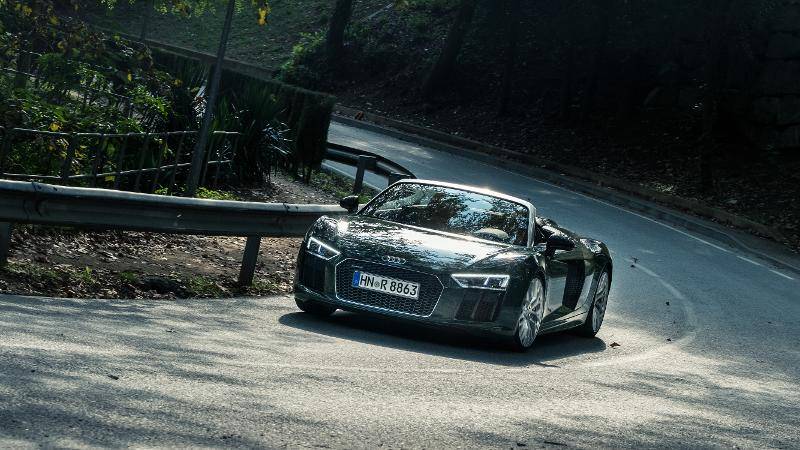
Compared to the original R8 Spyder, the design has been sharpened up quite a bit, and it's all the better for it. While it may not have quite the same in-your-face styling as some of its rivals, the Spyder's understated and purposeful looks - enhanced by the addition of distinctive sideblades, which shove air into the engine, and make the car's midriff a little wider - give it a certain presence and drama, whether it's parked up or going full pelt.

Going topless:


For purists, a cabriolet is always going to be seen as a compromise over a coupe equivalent - rigidity and stiffness are compromised by lopping the roof off, while the roof mechanism and extra engineering required to add the torsional strength lost by the roof all adds weight. But that's to ignore the sheer thrill of having the roof down, and the howl of the V10 ricocheting off the surrounding buildings and straight back into the cockpit.

Audi's done a stunning job here. The mix of carbon and aluminium makes the Spyder some 55% more rigid than the previous model, as well as being some 25kg lighter. Compared to its hardtop counterpart it's only 125kg heavier, which may seem a lot, but it's impressive given the level of engineering required.
The folding roof mechanism is a masterwork of mechanical dance, taking just 20 seconds from a single press of a button to reveal the sky, while if the urge to drop the roof is so great that you don't want to stop (or, less thrilling, if it starts to rain), this can be done on the move at speeds of up to 31mph.

Cockpit:

While it might not offer quite the same sense of occasion as slipping behind the wheel of a Lamborghini or Ferrari, the R8 Spyder's cockpit is still a very nice place to be, with lots of leather and carbon to deliver a very premium, high-end feel.

The R8 Spyder uses what's been termed Audi Virtual Cockpit, shunning traditional dials for a customisable digital display. Rather than having a multimedia interface (MMI) in the central console and the instrument panel up front, the two are combined into one high-resolution display, with the choice of three views: classic, infotainment and sport.
Google Maps is built in for navigation, while it's easy to partner your smartphone with the Spyder - provided you tick the Audi Smartphone Interface optional extra that is. This enables you to share mobile phone content via USB and display it on the MMI, either via Android Auto or Apple CarPlay. Another optional extra is the Audi Phone Box, which allows wireless charging simply by placing your phone on the storage compartment, as well as creating a wireless connection via the car's aerial.

Sound system:

If you ever tire of the stunning soundtrack of the R8's V10 engine, then you're in for a treat with the Bang & Olufsen Advanced Sound System. It's an optional extra that will set you back another £1,750, but you get yourself a 16-channel amplifier with 13 speakers dotted round the cockpit (including two in each seat headrest and a subwoofer in the passenger footwell) that will kick out 550 watts. 
The sound quality is stunning - whether you've got the roof up or down, the clarity and depth are mightily impressive.

How it drives:


You'd think a £130,000+ V10 supercar would be intimidating to drive, but that's not the case at all. With the roof up, the gearbox set to full auto and the Drive mode dialled into Normal or Comfort, you've got an incredibly comfortable and cocooned cruiser that will happily demolish those motorway miles, or be quite at home just pootling around town. Find a twisty A-road, drop the roof and change the engine mode to Individual or Dynamic, and the Spyder's Le Mans-winning DNA shines through.
Put your foot down and the Spyder surges forward, with the engine note changing from a deep rumble to a loud howl as it nears its redline. Flick the right paddle behind the steering wheel and the change is seamless, while the snarling crackle that greets this change of gear is incredibly addictive.

This level of performance should be terrifying, but the grip is staggering - the all-wheel Quattro technology that saw Audi dominate the World Rally Championships in the 1980s inspires so much confidence as you travel through a bend that you'd have to do something pretty dramatic to unsettle it.
With all this power you'd naturally want to be able to stop pretty sharpish, and the optional-extra ceramic brakes that our car had deliver incredible stopping power. They can be a bit snappy to start with, but once you've generated a decent amount of heat their stopping power is immense.

Verdict:


The Audi R8 V10 Spyder is an engineering masterpiece. Unlike some supercars that can be hard to live with on a daily basis, the Spyder is a true supercar that you can enjoy every day. It's comfy and quiet when you need it to be, but a flick of the switch will see it transform into a true howling and cackling supercar that will punch you in the back as you climb through the gears at a staggering rate.
The coupe may be lighter and just a bit quicker, but you'll soon forget about that with the roof down and the sound of that glorious V10, just a couple of feet away, screaming through the rev range. The R8 V10 Spyder really does take your breath away.

New Update On Handset Launch : Android One failed In India; Could Google Possibly Avoid Failure With Version 2.0?

Android One was launched amid much fanfare in India last year. Aimed at the entry-level users of the emerging Indian market, Google had teamed up with three well-known low to mid-range players such as Karbonn, Micromax and Spice. The Android One failed. They didn’t sell well and many major retailers even refused to stock them. The news had it that eight major retailers which have 1800 stores between them refused to stock the devices.
Some reports have been pointing at Google making a comeback with the next version of Android One with Lava. This is one of the reasons why new India-born CEO Sundar Pichai is here. Here’s what Google could avoid to ensure that Android version 2.0 manages to make a mark in India’s fierce mobile world.

Focus on hardware, software can’t be the selling point
Earlier, Google launched three phones namely,  Spice Android One Dream, Karbonn Sparkle V, and Micromax Canvas A1. Interestingly, due to Google’s list of rules, all three had the same low-end specs. The only differentiating factor was the brand name. Yes, they were almost identical in specs, and all you had to do is decide which brand you prefer. The hardware requirements were a small list of approved processors, cameras and other components. While reports have already been pointing out at this, it would be nice if Google went ahead and brought some lax to its rules. This will help the companies bring in better specs at affordable prices and eventually help compete with the likes of Xiaomi.

Now, the importance of Android One goes well beyond what you see. There is a reason why Android One is so important to India. China and India are the fastest growing smartphone markets, but China is a wasteland when it comes to Google service and generating revenue from them. The onslaught of Chinese vendors and their forked OS versions coupled with great hardware are getting popular in India too. To ensure not to see the same fate in India, Google is yet again trying its hand at revamped Android One. Android One is probably how Google wants to take its services to be at the forefront.
Phones models at varying budget prices
With Android One, Google is targeting new entry-level users. However, the entry-level markets have spruced up consumer expectations. A sub-Rs 3000 smartphone is a great idea, but if another device is offering much more for Rs 1000 more, wouldn’t consumer prefer that. Arguably, there are chances that first time users in rural areas may prefer a really low-end phone with alphanumeric keys. This makes it imperative to have different models and at varying price points. Thus, looking at Android One from a broader prospective is crucial.

Now, Google already has phones across price brackets. But for Android One to become a go-to phone under Rs 3000, will have to be a mix of many factors.
Brand matters
In India, brand matters. One may want to opt for a budget device, but are always looking for a value for money product from a decent brand. A Spice or Karbonn are often related to cheap, low end devices. This isn’t something what many users are looking for – especially if a Moto E from a seasoned OEM such as Motorola is selling at Rs 5000.

Online, offline marketing tactics
These days, we are seeing new ways of marketing handsets. From Xiaomi to the latest Qiku, all have formed newer forms to attract audiences. Google will have to bring more to the table in terms of marketing and selling the phones. Moreover, the previous phones were launched exclusive to an online site initially.

After they failed to capture market share, the devices went to offline stores. It should be noted that the phones are targeted at tier 2 and tier 3 cities, and offline channels would have played a bigger role in selling the phones if launched simultaneously on both platforms. Today, Android One already carried a failed tag, and wooing audiences will be even more difficult.

News Update New Handset Launched : Karbonn Alfa 112, Alfa A91 Power, Alfa A93 Pop, And Titanium S205 Plus Launched

Karbonn on Wednesday launched a range of new smartphones and feature phones in the market as a part of its festive offer. The company has introduced four new smartphones namely Karbonn Alfa 112, Alfa A91 Power, Alfa A93 Pop, and Titanium S205 Plus alongside two feature handsets - K18 Jumbo and M105.
The Android-based Karbonn Alfa 112, Alfa A91 Power, Alfa A93 Pop and Titanium S205 Plus are priced at Rs. 2,890, Rs 3,290, Rs. 3,490 and Rs. 6,790, respectively. The K18 Jumbo and M105 cost Rs. 990 and Rs. 940 respectively. The company said it would also be offering special festive season discounts of up to 50 percent on Titanium Mach Five, Titanium Mach Two and Titanium S201 via e-commerce websites.
The dual-SIM (WCDMA+GSM) supporting Karbonn Titanium S205 Plus (seen above) runs Android 5.1 Lollipop out-of-the-box and features a 5-inch HD (720x1280 pixels) resolution IPS display with Dragon Trail Glass protection. It is powered by an unspecified dual-core SoC clocked at 1.2GHz and clubbed with 2GB RAM. It also houses 16GB of inbuilt storage, which can be further expanded via MicroSD card (up to 32GB). In the camera section, the Titanium S205 Plus sports an 8-megapixel autofocus rear camera with dual LED flash and a 3.2-megapixel front-facing camera as well. The smartphone supports 3G, Wi-Fi 802.11 b/g/n, Bluetooth, GPS and Micro-USB connectivity features alongside proximity sensor, G-Sensor and comes backed by a 2200mAh Li-Po battery.
The Android 5.1 Lollipop-based dual-SIM (WCDMA+GSM) Karbonn Alfa A93 Pop (seen above) features a 4.5-inch FWVGA (480x854 pixels) resolution display; 512MB RAM; 8GB inbuilt storage, which can be further expanded via MicroSD card (up to 32GB); a 2-megapixel rear camera; a 0.3-megapixel front-facing camera, and a 1400mAh battery. Connectivity features and processor remains the same as Titanium S205 Plus.
The dual-SIM (WCDMA +GSM) Karbonn Alfa A91 Power (seen above) runs the older Android 4.4 KitKat out-of-the-box and features a 4-inch WVGA (800x480 pixels) resolution display; unspecified 1GHz processor; 256MB RAM; 512MB inbuilt storage, expandable via microSD card (up to 32GB), and Li-ion 2000mAh battery. The connectivity options and camera setup stay the same as Karbonn Alfa A93 Pop mentioned above.

The Android 4.2 Jelly Bean-running dual-SIM (GSM+GSM) Karbonn Alfa 112 (seen above) features almost the same specifications as the aforementioned Karbonn Alfa A91 Power but misses out on 3G connectivity and is backed by a Li-ion 1300mAh battery.

The dual-SIM (GSM+GSM) Karbonn K18 Jumbo feature phone sports a 2.4-inch LCD display, VGA (0.3-megapixel) rear camera, FM radio, GPRS, Bluetooth and is backed by a 1800mAh battery. The dual-SIM Karbonn K-Touch M105 sports a smaller 1.8-inch LCD display, digital rear camera and 800mAh battery with rest of the specifications same as the K18 Jumbo.

News Update On Gionee Handset Release : Gionee Elife E8 First Impressions: 6-Inch Flagship With Great Feature Set; Could Compete With Moto X Style

Gionee announced its flagship phone the Elife E8 at an event in New Delhi today. The Elife E8 will be successor to the Elife E7 which was launched in 2013. The Elife E8 is priced at Rs 34,999 and will be selling on Snapdeal from 12 October. Post the launch event we spent some time with the device and here are our first impressions.

Build and Design
The Gionee Elife E8 is quite a handful at its 6-inch form factor. While the bezels are thin, using the phone one handed is out of question, unless you have unnaturally large hands. The phone comes with a metallic edge which is complemented by a plastic rear cover which has a slight curvature, reminiscent of that seen on the Elife E7. The metallic edges give the phone an elegant look. The back cover is removable, but the battery is not.

The left hand side is clean whereas on the right hand side you have the volume rocker button, power/standby button and a dedicated camera shutter button. A 3.5mm audio jack graces the top edge and there’s the microUSB charging and data transfer port on the base.

On the rear side, you have a circular finger print scanner placed just below the 24MP camera. On the front, you have a 6-inch Quad HD display. There aren’t any physical buttons on the front portion of the Elife E8. The menu soft buttons are sadly, not backlit.

The phone will require two handed use for most users. Due to the smooth rear cover, the grip is a bit slippery.

Display
QuadHD displays have become a standard with most flagship phones these days and the Elife E8 is no different. It sports a 6-inch 2560×1440 pixel AMOLED display with Corning Gorilla Glass 3 protection. The colours appear vibrant and the text is sharp. But we will have to check the legibility in sunlight and video playback quality, which we will, once we get the review unit.

Chipset, RAM, Storage
The Elife E8 houses the MediaTek Helios X10 (MT6795) system on chip which houses a 2.0GHz octa core processor. This is paired with 3GB of RAM. The phone comes with 64GB of on board storage and you have the option to expand it to 128GB via a microSD card.

OS, Connectivity
The Gionee Elife E8 comes with Android 5.1 Lollipop and as is the case with most Gionee phones, there is the Amigo 3.1 user interface skin atop the Android OS. Gionee will be working with its Indian research team to add on more India specific features on the Amigo 3.1 UI. It will come with support for 9 Indian languages out of the box. The user interface on the Elife E8 felt really smooth as compared to what we had seen on the Elife E7 when it had launched. But we will need to use it more extensively to give a proper verdict.

The Elife E8 has a dual microSIM card configuration and it will support 4G SIM cards as well. It supports WiFi 802.11n, Bluetooth 4.0, GPS with A-GPS, FM and so on.

Camera
Gionee flagship phones have had good cameras and we were impressed with the 16MP shooter on the Elife E7. With the Elife E8, Gionee has gone a step further and added on a 24MP rear camera. This is complemented with an 8MP front-facing camera.

The 24MP camera on the rear side has a true tone dual LED flash unit. The camera user interface is quite intuitive. The Gionee Elife E8 comes with phase detect AF feature to help with faster focusing. But thanks to the poor lighting in the demo zone, we couldn’t try it out. The camera comes with many specialty modes such as Professional mode, Real HDR, Real Night, Magic Focus 2.0 and so on. The UltraPixel mode let’s you shoot an almost 120MP image by stitching around 5 images. The video camera is capable of shooting 4K videos as well.

We will need to use the phone’s camera extensively to be able to talk about the performance, as on paper it certainly ticks off all the right boxes, including a dedicated camera shutter button which will be appreciated by photography enthusiasts.

Battery
The Gionee Elife E8 houses a 3,520mAh Li-ion non-removable battery. Gionee claims that you can get up to two days of regular use with the E8, but we will hold back on that till we test the device.

Gallery

Conclusion
Gionee has upgraded its flagship after two years and it has put in a good overall feature set. The Helios X10 chipset with 3GB of RAM and 64GB storage, a 24MP shooter, fingerprint reader, 3,520mAh battery with fast charging technology are high end specifications. We will have to see how it comes together as an everyday phone, when we review it.

The Gionee Elife E8 is priced at Rs 34,999 and going by Gionee’s history, their flagship phone pricing has been premium since the launch of Elife E6. But this time around, Gionee has partnered with Snapdeal to sell the E8 online. This brings with it the hassles of registration. Considering this is a premium device, one should not be concerned about phone selling out within seconds as Gionee has promised a limited, although good volumes of phone for online sales.

At Rs 34,999, the Gionee Elife E8 will certainly have some good competition in the form of Samsung Galaxy A8, the just launched Motorola Moto X Style, and others phones such as the OnePlus One, Huawei Honor 7 and so on.

Do check back for the full review of the Elife E8 soon. In the meantime, do let us know your thoughts on the product, its feature set, price point in the comments section.

News Microsoft Product Update Report : Microsoft Office 2016 To Launch On 22 September

After officially rolling out Windows 10, Microsoft is now gradually releasing updates to match up the new operating system. The company is rumoured to release the final version of the Office 2016 next month.

WinFuture learned from a source close to Microsoft that the company will launch Office 2016 on September 22. The report also claims to have sources inside Microsoft who provided them with a leaked screenshot of the company’s intranet site.

A page called the Office 2016 Launch Hub stated, “We’ll release Office 2016 with updates for Word, Excel, PowerPoint, OneNote, Outlook, Skype for Business, Project, Visio, Access, and Publisher. The innovation wave continues in Q2 with the release of E5 and Skype for Business, and on-premise servers will follow.” Microsoft has apparently already informed its employees in the last few days that the official launch for Office 2016 will take place end of September.

Back in June, Microsoft had released Office 2016 for Mac along with new apps for Android phones as well. An Office 365 subscription gets you – $70 for a single Mac or Windows PC at a time, or $100 for five. Mobile apps are free, though a subscription unlocks advance features that most people won’t need. Mac and Windows versions are sold the traditional way, too, with a one-time payment, though you can’t use Office on another PC without buying it again.

Update New Product Lauch : LG Launches ‘World’s First 4K OLED TV’ In India Starting At $57923

LG has launched the world’s first 4K OLED TV in India. The 55-inch variant is priced at Rs 3,84,900 while the 65-inch model at Rs 5,79,900.

The new LG OLED 4K TV features a transparent stand and the back cover is free of fasteners and holes. In addition, the TV also features 3D and Harmin Kardon sound technology. 3D glasses are bundled with the TV.

The company’s curved TVs are based on LG’s proprietary WRGB technology that boasts 33 million colour sub-pixels (about 27 million more than a conventional full-HD tv) to offer better colours and contrast ratio along with deeper blacks. The display offers a 5.9mm thickness as well.

The TV also has a maximum response time of 0.001ms (1000 times more than conventional LCD TVs) for blur free viewing, claims the company and the TV is also powered by webOS smart TV platform and LG’s magic motion remote that also supports voice recognition. In terms of connectivity, it supports Wi-Fi, Miracast, MHL and Intel WiDi.

Howard Lee, Director-Home Entertainment, LG India, said of the new range, “Once again LG has proved that it is a frontrunner when it comes to innovative technology. With the LG 4K Oled TV, we promise consumers in India the ultimate immersive cinematic experience. Time and again we have initiated ground-breaking innovation and raised the bar not only for ourselves, but for the industry as well. This latest Oled TV underscores LG’s commitment to bringing the best in home entertainment to our consumers.”

News Handset Launch Update : Oppo R5s With 4.85mm Thickness, 3GB RAM Launched

Chinese manufacturer Oppo has just unveiled its latest mid-size device, the R5s, an update of last year’s R5. That being said the R5s does inherit same niggles from its predecessor, which includes the need to carry a USB to 3.5mm Audio jack adapter. The Oppo R5s is an upgrade to the previously launched R5 and the new variant comes with a couple of new features and hardware improvements.

The Oppo R5s hasn’t received an official announcement, but it is now listed on the company’s official European website.

The 6-inch Oppo R7 Plus is a capable device, with 3GB of RAM, 32GB of storage (expandable via microSD memory cards), a 13-megapixel camera and a fingerprint reader. The phone’s design allowed the camera to be turned from the back to the front, and to various angles as well.

Coming to the detailed specifications, the display screen is 5.2 inch full HD (1080X1920 pixels) with a pixel density of 423 ppi. The camera department is handled by a 13-Megapixel primary Sony IMX214 sensor and a 5-Megapixel secondary sensor with a 83-degree wide angled lens.

The smartphone also supports 4G, Wi-Fi, Bluetooth 4.0 and Global Positioning System and could be priced in the range of Rs 20,000-25,000.

It runs on Android 4.4 Kitkat which is layered with the company’s proprietary ColorOS 2.0.1.

The R7 Plus also features Oppo’s VOOC fast-charging technology, which – according to the specs – gets you two hours of conversation after five minutes of charging. The Oppo R5s measures 148.9×74.5×4.85mm and weighs 155 gram.

News Handset Launch Update : Next-Gen Android One Phone Launches In India For $176

The Lava Pixel V1 offers a solid value for the price, combining mid-range hardware with the latest Android software updates from Google.

Google's Android One hardware partners are beginning stage two of the low-cost phone strategy: Say hello to the Lava Pixel V1.

The Android One handset launched online in India on Monday for ₹11,350, which works out to $176.71. And for under two-hundred dollars the Pixel V1 in some ways rivals smartphones that arrived just two years ago for much more money.

Running Android 5.1 Lollipop, the dual-SIM 3G Pixel V1 is powered by a 1.3 GHz quad-core chip made by MediaTek and is paired with 2 GB of memory. There's 32 GB of on-board storage and the capacity can be expanded by another 32 GB with a microSD card.

Lava says even though the Pixel V1 has 5.5-inch display, the phone feels like a model with a 5-inch screen because it's not very wide. Don't expect a full HD screen though: At this price, you're looking at 1280 x 720 resolution.

There's also some compromise on the camera sensors. Lava advertises the phone as having a 13 megapixel rear camera and an 8 megapixel front camera but those numbers are boosted by software enhancements; the actual sensors are 8 and 5 megapixel models. The rear sensor does have an f/2.0 aperture and 1.4 micron pixels, however, which should allow for solid low-light photos.

Aside from the hardware and appealing off-contract price, the software has a key benefit. Since the phone is certified for the Android One program, software updates are directly controlled by Google, similar to the company's Nexus line of phones. That means there's no or little waiting to get the latest version of Android installed.

Having launched last September, Google's Android One program hasn't yet made a major impact on the smartphone market.

The strategy, however, is sound: Work with hardware partners in upcoming and emerging markets to offer high-value handsets that aren't saddled with carrier control. It's too soon to say if the approach is going to be a success but Google and its partners are on the right track.

Other Android partners can surely offer less expensive phones that have more capabilities, but none of them can provide the software update benefits of Android One.

News LG Handset Released Update : LG G4 And G4 Stylus Prices Slashed In India

LG today announced price reductions on the LG G4 and G4 Stylus in India. The LG G4 is now made available at Rs 45,000 (for the Leather back variant) and Rs 40,000 (for the Ceramic white variant), the LG G4 Stylus will be priced at Rs 21,000. Launch prices for the LG G4 and G4 Stylus in India were Rs 51,000 and Rs 24,990 respectively.

With this move, LG aims to offer consumers a chance to buy its products at festive prices. More so, this looks likes a competitive strategy to take on some of the similar offerings but other smartphone companies.
Mr. Amit Gujral, Marketing Head, LG Mobiles, India said, “This festive season we wanted to give consumers something to cheer about. The G4 and G4 Stylus are our best offerings in India this year and we have received a phenomenal response to these smartphones till now. With a further revision in prices, we are extending the availability to more and more people to enjoy the superior immersive & innovative experience these phones offer.”

The G4 sports a 5.5-inch display with 2560 x 1440 pixels of resolution, same as its predecessor. The device boasts of Slim Arc design, which means it has a slight curve, but not as much as the G Flex. This subtle curve will ensure the display is less likely to break upon fall. It is powered by the Qualcomm Snapdragon 808 processor coupled with 3GB of RAM. It will be available with 32GB onboard storage, expandable via microSD card slot up to 128GB.

On the camera front, the G4 comes with a new 16-megapixel sensor with f/1.8 lens and improved image stabilisation. It gets a new ‘color spectrum sensor’ with more accurate color and white balance. For selfie lovers, it comes with an 8MP front camera. The device runs Android 5.1 Lollipop along with a layer of LG’s custom interface. It uses something that LG calls ‘human-centric UX’ 4.0, promising a more intuitive experience. A 3,000mAh removable battery completes the package.
On the other hand, the LG G4 Stylus, sports a 5.7-inch display with 720 x 1280 pixels of resolution. Needless to say, it accommodates a rubberdium stylus for taking notes. The G4 Stylus runs Android Lollipop and gets its UI from the 2015 flagship G4 that features UX 4.0.

The 4G LTE variant comes powered by a 1.2GHz quad-core Qualcomm Snapdragon 400 processor and 1GB RAM. It gets a 13-megapixel rear snapper and a 5-megapixel front-facing camera. The 8GB onboard storage is expandable via microSD card. Finally, a 3000mAh removable battery completes the package.

LG G4 detailed specifications:
 
LG G4 Stylus detailed specifications :
 

News OnePlus Two Update : OnePlus 2 First Impressions - Brings In Some Design Finesse And An Improved Camera

OnePlus 2 was launched amidst much fan fare considering it was the first virtual reality launch of a smartphone ever. The phone packs in some impressive specifications and also has prices starting from Rs 22,999 for the 16GB version. The OnePlus 2 will launch in India on August 11. So before we start talking about performance numbers, here is a quick first impressions about the latest flagship phone from OnePlus which it has already touted as ‘2016 Flagship Killer’.

Build Quality and Design :
The OnePlus 2 has redesigned the edges to some extent but the rear side makes you feel at home. The sandstone black cover, which is now easily removable, has that familiar coarse feeling. The phone has a slightly curved design on the back which helps with the grip. The edges have got a metallic treatment with champfering on the edges to give it that classy look.
IMG_20150805_161012042
On the right hand side towards the top portion, you have the power/standby and volume rocker buttons. The top edge has the 3.5mm audio jack and at the base you have the USB Type-C port in the centre surrounded by two speaker grilles – which is new. On the left hand side you have notifications notch called the Alert slider, which has a nice feedback to it. It lets you control notifications by sliding it from bottom to top.
IMG_20150805_160842202
The OnePlus 2 comes with a 5.5-inch display and at the base of it you have a fingerprint scanner. It is not a button per se, but it has a clear rounded rectangular marking. This is surrounded by two soft keys which light up when the phone is on. On the rear side, the camera is placed bang in middle with a dual LED flash unit on top and the laser autofocus system below the 13MP rear camera.

Display:
IMG_20150805_161330694
OnePlus has stuck with the 5.5-inch full HD display for the OnePlus 2 instead of going for the QuadHD display. OnePlus makes use of an IPS panel and the display looks as good as the OnePlus One. The display looked sufficiently bright although glossy. We will need to watch movies on it to check for any backlight bleeding and use it in sunlight to test its legibility in bright outdoor situations.

Chipset, RAM, Storage :
The OnePlus 2 comes with impressive internal specifications. It is powered by Qualcomm’s flagship Snapdragon 810 SoC which has a quad-core Cortex A57 and a quad-core Cortex A53 and has the Adreno 430 GPU. This is paired with 4GB of RAM for the 64GB storage variant. The 16GB storage variant OnePlus 2 will come with 3GB of RAM. These are topline specifications, and naturally when using the review unit over a day, we did not notice any lag or slow down. Of course, we will be doing the complete real world testing of the phone.

OS, Connectivity :
Unlike the OnePlus One, the OnePlus 2 has no Cyanogen branding on its rear side. This is because, the phone comes with Android 5.1 with OnePlus’s own OxygenOS skin atop it. The OxygenOS skin looks quite similar to stock Android Lollipop design and has a few refinements, such as the frequently used apps and contact list on the left most swipe.
IMG_20150805_161250638
The OnePlus 2 supports a dual 4G nano SIM card slot which is accessible on removing the rear cover. Thanks to the slots located under the cover, you do not need a pin to remove the SIM card slots, you can just slide them using your nails. Apart from this, the phone supports Wi-fi 802.11 ac, Bluetooth 4.1, GPS with A-GPS, GLONASS and so on. One omission on the connectivity front is NFC, which could have been easily paired with the fingerprint sensor to verify NFC payments. Although this is a niche market segment in India and not really relevant, globally that is not the case.

With the USB Type C connection, the OnePlus 2 will be the first phone to be selling with that connector in India.

Camera :
IMG_20150805_160754139
OnePlus 2 has really spruced up the camera department. You now get a 13MP rear camera with a pixel size of 1.3 microns. Also the camera will come with an optical image stabiliser to help you take stutter free images and videos. We will need to see if this is as impressive as the one we had seen on the LG G4. Another impressive feature on the rear camera is the laser auto-focus mechanism. This should help improve the focus acquisition speed. However, the real test of the rear camera will lie with low light photography, which is was really not impressive at all on the OnePlus One. On the front you have a 5MP camera for your selfies. The camera user interface is quite different from the one seen on OnePlus One as well.

Battery:
The OnePlus 2 comes with 3,300mAh Li-polymer non-removable battery which is a bump up from the 3,100mAh battery that was seen on the OnePlus One. Ideally, one should be able to pull of a days worth of usage on regular use, but we will need to confirm that only after reviewing the phone. Also the OnePlus 2 does not come with the Qualcomm QuickCharge feature.

Conclusion:
The OnePlus 2 has certainly got off to a good start, after Carl Pei announced the price of Rs 24,999 for the 64GB storage variant of the phone. Considering the price of Rs 31,000 was doing the rounds of online forums before the launch date, this is a welcome change. However, we will have to see how OnePlus has tackled the apparent heating issues associated with the Snapdragon 810 SoC. There are lot of new things to try out on the OnePlus 2 such as the finger print scanner, interchangeable back and home softkeys, the improved camera and so on. You will have to check back for the full review of the OnePlus 2 which we have already started working on.

News Sony New Handset Update: Bezel-Free Sony Xperia C5 Ultra and Xperia M5 Leak In New High Definition Images Available

Sony is scheduled to announce the new Xperia C5 Ultra and Xperia M5 in the next couple of days. Prior to that announcement, newly leaked images were spotted online, giving us early glimpses of the handsets' design features.
The leak comes from the Russian tech site Hi.Tech.Mail.ru. The original post, according to 9to5google.com, was time stamped for Aug. 3 and had now been taken down.

The upcoming C5 Ultra, as the name suggests, is billed as the successor to the 5.5-inch Xperia C4. The "ultra" moniker could refer to a number of things. First among them is the C5 Ultra's bigger display of 6 inches compared to the C4's. The next thing to consider is its upgraded battery size of 2,930 mAh which is bigger than the C4's 2,600 mAh battery. Other major comparisons include the C5 Ultra's 13MP wide-angle front-facing camera versus the C4's 5MP and the C5 Ultra's ultra-thin 0.8 mm bezel versus the C4's bezel measurement of 2.2 mm.

A few days ago, Tech Times reported on a leaked manual of the Xperia C5 Ultra, which confirms the handset's bezel-free display. The report also noted the handset's rear and front cameras to both have a flash.

The second image in question is purported to be the Xperia M5, which is reminiscent of the Sony Xperia Z3. Unlike the huge C5 Ultra, the M5 exudes a certain level of familiarity that makes it blend easily with the other Sony devices that are now available on the market.

The Xperia M5 features a 5-inch Full HD IPS LCD display and also sports a 13MP camera on the front and rear. It runs an octa-core Media Tek Helio X10 processor and has a RAM of 3GB, internal storage of 16GB and a microSD slot. It also boasts an IP65/IP68 dust and water resistance certification.

Among the two, the Xperia C5 Ultra will probably get more attention because of its bigger display and the 0.8mm wide bezels. Other notable features include a RAM of 2GB, internal storage of 16GB and an octa-core Media Tek Mt6752 processor.

The Xperia C5 Ultra is expected to retail at around $350 while the Xperia M5 will be somewhere near the $400 price point. 

Gallery :


News Drone Tech Update : This Drone Delivers Beer: ​Flytrex Launches World's First Consumer Delivery UAV

Flytrex, a maker of drone tech for the consumer market, has launched a new drone designed to deliver items including -- if the promotional photos are an accurate representation -- a cold beer. Note to editors: I think I finally get what the drone hype is all about.

"Delivery is one of the possible things you can do with Sky, and it's the thing that makes the most noise," Flytrex co-founder Yariv Bash tells me over the phone when I bring up the photo, "but we're also talking about a cloud-connected drone with web API."

Flytrex has been around for about a year and this is its first foray into ready-to-fly drone hardware. Bash is also a founder of SpaceIL, an Israeli nonprofit that's competing in the Google Lunar X Prize and has raised more than $50M. He and a friend began playing around with drones and had the idea of trying to gamify the experience. They came up with an idea to create a kind of black box for drones. "You could use it to upload data, see where it's been, what the altitude was," says Bash. "There wasn't anything on the market that you could just plug into your drone."

The black box became Flytrex's first product, and the next logical step was to create a real-time version of the device. The live product became known as Live 3G and is a common add-on for hardcore drone enthusiasts. "With iPhone or Android you can see where you are in real time. So you can fly drones a bit further down the road than line-of-site." Many newer drones offer similar capabilities off-the-shelf. It's a fast-moving market, after all. But the Core 3G remains a robust add-on and is still a big seller for the company.

Flytrex's real breakthrough, though, was realizing that to properly gamify the experience of flying a drone, they had to build a community around flying. With the black box technology sending data to their servers, they decided to start issuing flying badges for various feats -- a badge for reaching a certain altitude, one for flying a minimum distance, etc. Drone enthusiasts took to the idea, and the company embraced an emerging community by logging completed missions on its site and issuing challenges to users.
"We have a lot of interaction with users. It's really become the core part of what we do."

As Bash tells it (he's a good storyteller) he and his friend left the house to fly a drone one day when they realized they had forgotten something. With drone delivery a topic of much speculation in the logistics sector, the pair wondered what it would take to build a drone that could return to the house and carry the item back. Then they started pondering how they would design such a drone from the ground up.

"We thought, 'We have the infrastructure, we've sold thousands of these black box devices, we have users all over the world, why not build a drone designed around the cloud?"

The company is touting the Flytrex Sky, therefore, as more than just a beer delivery device. "It's the first cloud-connected drone," says Bash. The company has created apps to control the drone. One interesting feature, which is geared toward delivery, is the ability to send the drone to a pre-determined location where another user can take over control with their phone, guiding the drone in for a precise landing. The device essentially asks the receiver for permission to land, so there's no loss of control.

The drone can fly about six miles with a light payload, like a smartphone, and can hover about half-an-hour. That means it can easily exceed line-of-sight limits set by agencies such as the FAA in the U.S., which are nonetheless fundamentally difficult to enforce. ("We always tell users to obey all local laws," says Bash.) The maximum payload is about three pounds.

While it's fun to joke about a drone serving as a beer delivery device, Flytrex is turning to its community of users to unlock the real potential of a sub-$600 delivery drone.

"We've already been approached by a few guys in Africa who are thinking of using it to transfer medicine between villages. It's perfect, because there is excellent cell coverage in Africa, which has few overhead phone lines, and medicine is so lightweight."

That sounds like a very worthy use of the technology. In the meantime, I'll be waiting for my flying beer.

News Google Glass Update : New Google Glass For Businesses Will Reportedly Attach To Other Eyewear

The next edition of Google Glass will target enterprises and feature an attachable design, a news report suggests, shedding new light on rumors that have been circulating over the past several months.

The device will feature a curved, rectangular form factor much the way the first, consumer-focused Glass edition did, according to an article in the Wall Street Journal. It will differ from that version, however, in that it will reportedly feature a button-and-hinge system rather than a fixed frame, making it attachable to different kinds of eyewear.
Google aims to have the device in use by this fall at companies in healthcare, manufacturing and energy, and is already distributing it to software developers creating applications for that purpose, the WSJ reported on Thursday, citing anonymous sources familiar with the situation.

A new consumer version is also in the works, but it reportedly won’t appear for at least a year.

Google didn’t immediately respond to a request to comment for this story.

The original $1,500 Google Glass version is widely considered to have been released before it was ready for consumer use, and it encountered a strong backlash over privacy concerns.

Expected in the new, enterprise version are a faster Intel processor and improved wireless connectivity. An external battery pack connects magnetically to the device, the latest news suggests, promising better battery life than what was offered by its predecessor.

Finally, a longer and thinner prism display is adjustable both vertically and horizontally, the WSJ said, offering improved flexibility.

“The new Google Glass story sounds much better the second time around,” said wireless and telecom analyst Jeff Kagan.

Consumers will probably become more comfortable with such technology eventually, but “it will take a while before the average person gets to that point,” Kagan added. In the meantime, “taking Glass to certain industries to start sounds like a much better idea.”

News Apple New Handset Update : Apple 'iPhone 6s' And 'iPhone 6s Plus' Leak Suggests Upcoming Device Will Still Sport A Protruding Camera

The next-generation Apple smartphones dubbed iPhone 6s and the iPhone 6s Plus may sport a protruding camera as found in the iPhone 6 and the iPhone 6 Plus, per rumors.

The protruding camera of the iPhone 6 and the iPhone 6s Plus resulted in many customer complaints as users were unable to lay their handset flat on the table as the camera lens sticks out by around a millimeter.

"This protruding camera is going to drive my OCD and anxiety riddled brain mad immediately. I have never used a case but I have a feeling I will have to succumb to one this time around in order to balance it out," complained a Reddit user. "I have always liked how the iPhone is sleek and simple, the protruding camera lens is a bit annoying."
Experts believed that Apple will make slight design tweaks to the next-generation iPhones so that the camera lens does not protrude. However, a report from French website Nowhereelse leaked images of the camera rings that will be used in the upcoming iPhones, which suggests that Apple will not make changes to the design of the iPhone 6s and the iPhone 6s Plus and customers will have to bear with the protruding camera.

The placement of the camera on the iPhone 6s and the iPhone 6s Plus may remained unchanged but the French website reveals that the Apple smartphones will get a 12MP iSight camera and a 5MP FaceTime camera.

The iPhone 6 and the iPhone 6 Plus are equipped with an 8MP iSight camera and a 1.2MP front-facing camera, which has not changed since the release of iPhone 4s.

The "S" models of the iPhones do not get major changes but rumors claim that the iPhone 6s and the iPhone 6s Plus may come running on a faster A9 processor and 2GB of RAM. The new iPhones are also estimated to get a new NFC chip, better voice quality and a new touch display.

The existing iPhones are available in three colors options: Space Gray, Gold and Silver. Rumors suggest that Apple may launch the iPhone 6s and the iPhone 6s Plus in rose gold color as well, which may attract more customers. However, it remains to be seen if the protruding camera in the upcoming iPhones will deter customers from buying the handsets.

The production of the iPhone 6s and the iPhone 6s Plus are said to be underway and the handsets are expected to be launched in September. Customers will have to wait another few weeks before they can get a glimpse of the next-gen iPhones.

News Mobile Technology Update : Google Trials LTE In Project Loon’s Balloons Over Brazil

A year on from firing up its first wi-fi balloons in New Zealand, Google has flown its first LTE-equipped balloons in a remote town in Brazil.

Project Loon may have been overshadowed by Google's more recent $500m aerial manoeuvre and speculation it will launch a constellation of satellites . But the project which started in New Zealand nearly a year ago and aims to deliver broadband to underserved parts of the world is making progress.
Google announced on Monday it had launched an LTE-equipped balloon on the rural outskirts of Campo Maior in the north east of Brazil, connecting a local school Linoca Gayoso to the internet for the first time.

The community currently doesn't have a broadband or mobile service, which means locals rely on a few locations where a weak mobile signal can be found — including up in trees or next to soccer goalposts.

The addition of LTE to the balloons brings several benefits, according to Google. Markets where 4G LTE has launched know it for higher speed mobile broadband, but in Loon it serves a different purpose. It could allow Google to provide an internet signal directly to mobile phones as well as deliver services over longer distances than wi-fi.

(The radios used in Google's New Zealand launch operated on unlicensed spectrum in the 2.4GHz and 5.8GHz bands used in wi-fi.)

The other benefit of LTE is that carriers are already using it on their networks. "This means that when Loon partners with telcos to deliver last-mile connectivity, we will be able to use the telecommunications companies' existing infrastructure, which will allow us to deliver service to rural and remote users seamlessly and quickly," Google said.
In its Brazilian LTE Loon trial, Google worked with two local operators — Vivo and Telebrás — to essentially extend the reach of their respective 3G and backhaul networks.

"Working with both partners allowed the team to confirm that Loon could extend LTE coverage from a 3G wireless zone or from a fibre backbone," Google said.

Google said its intent since launching the first balloons was to find partners and says its New Zealand launch was supported by Vodafone NZ.

Before the project launched, the Loon team were actually planning to buy spectrum for itself, "Captain of Moonshots" Astro Teller told Tech Crunch Disrupt earlier this year.

However, Teller said that Google CEO Larry Page wouldn't allow it, in part because it would have sparked fears that Google was "invading" the country where it launched.

The Brazilian LTE Loon trial comes after Google applied to the US communications regulator to test Loon in North Nevada using spectrum designated for LTE services. Earlier this month one of the Loon balloons, likely launched from Nevada, crashed in a remote part of Washington State, cutting a power line.
 
Support :. Copyright © 2015. The Technology Zone - All Rights Reserved
Template Created By Gourav Kashyap Proudly Powered By Blogger