


Our Verdict :
While the OnePlus 2 beats everything in its price bracket, it isn't the out and out flagship killer like its predecessor. There are no heating issues, and the phone does a good job in most areas. If you're buying a new phone, this would be a good choice, but if you currently own a OnePlus One, stick to it.
About a year ago, when I first got my hands on the OnePlus One, the smartphone market was undergoing a sea change. Today, we’re accustomed to it, to the point where we expect it. In fact, the incremental updates that we get today are even boring at times, and coming from a geek, that's saying something. So, when the OnePlus 2 was handed to me, it came as no surprise, despite all the consumer interest around it.
 From 29th to 10th, it's been about two weeks now, and the OnePlus 2 has been my daily driver all this time. But before I get on with the OnePlus 2 review, there are a few things that need to be mentioned. Take it like a key to reading this review, just like pointers to recognise stuff on a map.
First, I came into this review with a huge prejudice against the Snapdragon 810, having seen it first hand in the Xperia Z3 Plus. Second, I personally do not like big phones, unless they're built like the LG G3 (I still treasure the size my first gen Moto X comes in). Third, I'd pick battery life over thinness any day. Lastly, no matter what impression you get from this review, you should, under no circumstance abandon your OnePlus One for the OnePlus 2. The OnePlus 2 is an incremental update like so many other phones today, and doesn't really qualify as an update to the amazing phone that the OnePlus One was.
You still with me? Well, then here's my review of the OnePlus 2...
Build & Design :
About a year ago, when I first got my hands on the OnePlus One, the smartphone market was undergoing a sea change. Today, we’re accustomed to it, to the point where we expect it. In fact, the incremental updates that we get today are even boring at times, and coming from a geek, that's saying something. So, when the OnePlus 2 was handed to me, it came as no surprise, despite all the consumer interest around it.

First, I came into this review with a huge prejudice against the Snapdragon 810, having seen it first hand in the Xperia Z3 Plus. Second, I personally do not like big phones, unless they're built like the LG G3 (I still treasure the size my first gen Moto X comes in). Third, I'd pick battery life over thinness any day. Lastly, no matter what impression you get from this review, you should, under no circumstance abandon your OnePlus One for the OnePlus 2. The OnePlus 2 is an incremental update like so many other phones today, and doesn't really qualify as an update to the amazing phone that the OnePlus One was.
You still with me? Well, then here's my review of the OnePlus 2...
Build & Design :

The Sandstone back remains, but it's on a thin plastic plate this time.
The build and design of the OnePlus 2 is the embodiment of the fact that it's an incremental update. The Sandstone back looks the same as in the One, but feels to be of somewhat lower quality. In giving the phone a removable back, OnePlus has had to make this onto a thin plastic plate, as opposed to the hard and full Sandstone finish on the OnePlus One. By lower quality, what I essentially mean is that the finish feels rougher on the OnePlus 2.
The build and design of the OnePlus 2 is the embodiment of the fact that it's an incremental update. The Sandstone back looks the same as in the One, but feels to be of somewhat lower quality. In giving the phone a removable back, OnePlus has had to make this onto a thin plastic plate, as opposed to the hard and full Sandstone finish on the OnePlus One. By lower quality, what I essentially mean is that the finish feels rougher on the OnePlus 2.
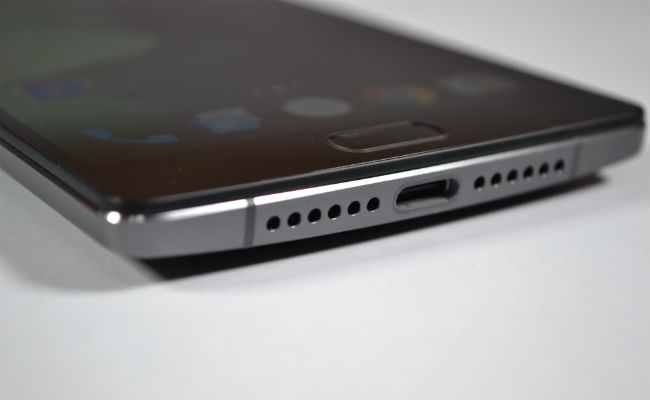
The USB Type-C port ensures that you have to carry your charger around all the time. Good that phones are adopting the new standard though.
It feels good though, and I daresay different. Carrying the OnePlus 2 around, I always felt the bulk and heft of the device, and what's surprising is that I liked it. It reminds me a lot of the Moto Turbo, even though it isn't as thick or heavy, or even as easy to use. The phone isn't really light, but it isn't heavy enough to dislike.
It feels good though, and I daresay different. Carrying the OnePlus 2 around, I always felt the bulk and heft of the device, and what's surprising is that I liked it. It reminds me a lot of the Moto Turbo, even though it isn't as thick or heavy, or even as easy to use. The phone isn't really light, but it isn't heavy enough to dislike.

The 13MP camera on the back has a laser assisted auto-focus system this time.
To all this, OnePlus has added a metal frame. There are two reasons for this — the first, to cover the 'metal build' required of ‘premium phones today, and second, to make the back removable, which it needs in order to make the styleswap covers usable. It doesn't really add anything to the overall look and feel of the phone. In fact, I find it to be a mismatch with the company's new wood finish Styleswap covers.
To all this, OnePlus has added a metal frame. There are two reasons for this — the first, to cover the 'metal build' required of ‘premium phones today, and second, to make the back removable, which it needs in order to make the styleswap covers usable. It doesn't really add anything to the overall look and feel of the phone. In fact, I find it to be a mismatch with the company's new wood finish Styleswap covers.

The fingerprint sensor can do more than just recognise fingerprints.
Like I said before, I personally dislike big phones, but not once over the two weeks have I grimaced over the size of the OnePlus 2. It slipped into my pocket just fine and it never felt imposing or unnecessary.
Display & UI :
Perhaps the one aspect of the OnePlus 2 that I disliked is its display. The 5.5 inch FHD display is sharp enough, but it's dim, not something I like from my flagship killers. What I dislike more is how easy it is to figure out that OnePlus has cut costs here. Turn on video on the camera and move the phone around and you realise the low refresh rate of this display. Sure, I’m nitpicking, but this is a flagship killer isn’t it?
The flaws in the display are further substantiated by the UI. OxygenOS seems too much like a work in progress. My call recorder app never got up and running, while the UI had far too many other bugs as well. On no less than three occasions, I found my cellular data turned off for no reason, while the Google search bar on top of the screen would disappear at least once a day. Even the fingerprint sensor failed to recognise my print every time the phone was kept on a desk instead of my hand. The phone froze a few times due to UI glitches and the proximity sensor malfunctioned every time I took a call, resulting in some app being opened in the background whenever I got off the call, or calls being put on hold etc. without me actually doing so. It almost felt like I was using a pre-production sample or a beta product sometimes.


These are just three examples of the buggy UI. All the icons disappear (on the left), and the Google Search bar also disappears often (on the middle), and the Notifications dropdown gets stuck (on the right).
The bugs would be irksome for a lot of basic users and even power users, but there is a kind of a statement here. OxygenOS in many ways just what I want a custom UI to be. It's not a sea change from stock Android and additions like the Shelf screen are a sign that OnePlus is developing something over the long term. It's almost an Apple-like approach, just not as polished. OxygenOS is same as Android, yet different, meaning the Shelf screen can be accommodated in the OnePlus One later, while next generations of OnePlus devices will bring new features that get added to the OnePlus 2 and so on. It would be worth mentioning that even as you read this review, OnePlus is pushing updates to the pre-sale devices that me and someof my compatriots have.
The bugs would be irksome for a lot of basic users and even power users, but there is a kind of a statement here. OxygenOS in many ways just what I want a custom UI to be. It's not a sea change from stock Android and additions like the Shelf screen are a sign that OnePlus is developing something over the long term. It's almost an Apple-like approach, just not as polished. OxygenOS is same as Android, yet different, meaning the Shelf screen can be accommodated in the OnePlus One later, while next generations of OnePlus devices will bring new features that get added to the OnePlus 2 and so on. It would be worth mentioning that even as you read this review, OnePlus is pushing updates to the pre-sale devices that me and someof my compatriots have.


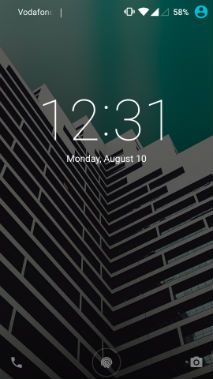
(L-R) Lock Screen, Home Screen and Shelf

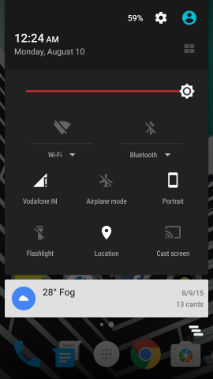

(L-R) Home Screen customisations, Multitasking screen and Quick Settings
The Shelf screen, which shows my most used apps and favourite contacts, was one of two features I really used. The other one being the hardware button to switch from All Notifications to Priority and No Interruptions modes. I would have liked if OnePlus could make this button programmable for other activities as well, but this works for now. If you happen to be coming from an iPhone background, you would appreciate this button even more.
The Shelf screen, which shows my most used apps and favourite contacts, was one of two features I really used. The other one being the hardware button to switch from All Notifications to Priority and No Interruptions modes. I would have liked if OnePlus could make this button programmable for other activities as well, but this works for now. If you happen to be coming from an iPhone background, you would appreciate this button even more.
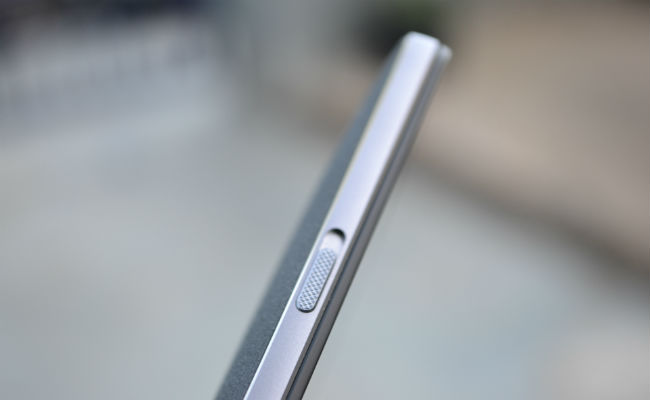
The hardware button for toggling between various interruption modes is useful. We wish it was programmable for more though.
Fingerprint Sensor :
Faster than the Touch ID eh? Not quite. As I mentioned earlier, the fingerprint sensor would not recognise the print whenever the phone was kept on the desk. While the OnePlus 2’s fingerprint sensor is useful and can be worked with, Apple’s Touch ID is just a tad better still I think.

While we think Apple's Touch ID is still a tad better, OnePlus' fingerprint sensor is pretty functional, except for some bugs.
Performance :
The question you should be asking here isn’t whether the OnePlus 2 heats up, but whether it heats up enough to be an issue. As I mentioned before, I was put off by the Snapdragon 810 earlier, but OnePlus has downclocked the SoC, going for almost 30% lesser performance. Delhi is one of the worst places for such an SoC though, especially during the summers.
Surprisingly though, the OnePlus 2 came out with flying colours no matter how hard I tried to get it to heat up. I’m in no way saying that the phone doesn’t heat up, it does, but it isn’t the abnormal heating that we’ve known the Snapdragon 810 for. I’ve played games like Injustice: Gods Among Us and Marvel: Contest Of Champions on this phone continuously for two hours without ever feeling any abnormal heat. It seems to be generating just the amount of heat that any SoC today would.
There are two things happening here. Firstly, the reduced clock speed of course helps. Secondly, the cooling paste that OnePlus has added allows the temperature to be reduced by 5-10% more. More importantly though, the paste cools down the SoC fast, meaning if you’re in an air conditioned room and your OnePlus 2 is a little hot, put the phone down for a minute and it will cool down. Even when I was not playing games in air conditioned room, the phone never really heated up enough for me to complain.
The reduced clock speed does hamper the phones number crunching abilities though. Hence, the benchmark scores that you see on the OnePlus 2 aren’t as groundbreaking as the OnePlus One’s. Of course, this phone surpasses its predecessor, but not by a lot. In regular usage though, the 1.7 GHz octa-core processor is everything you need and more. The OnePlus 2 runs those high end games I mentioned like a charm, and while there are some lags over extended periods of gaming, I have no complaints on the performance part.
All this is complemented by the 4GB RAM on this phone. I barely found apps being suspended, even when I opened them after a good 12 hours or so, after gaming on the phone in between.
Battery :
Along with the display, the OnePlus 2 is somewhat weak on the battery front as well. While the phone can last for a full day, you would have to try hard for it. Also, if you’re gaming a lot, then make sure the USB-Type C charger is on you at all times. With about 50% battery, the OnePlus 2 drops to 10% within an hour.
You can read about the OnePlus 2’s battery in more detail here.
Camera :
If it was about simply covering the flagship features, the OnePlus 2 does well with the ‘laser assisted auto-focus camera’. The 13MP camera on the back is also much improved as compared to the OnePlus One. It is worth mentioning though that the OnePlus 2 doesn’t focus as fast as the LG G4 though.
Gallery :


In addition, OnePlus’ default app for images is Google Photos, which means every time you swipe to see an image you clicked, the phone will freeze for a second. It’s very similar to what happens on Samsung phones when you swipe across to Flipboard. Photos is not integrated into the camera app, hence, when you swipe to see the image, the screen will freeze for a few seconds before the image opens completely.
Overall, it’s a very likeable camera on the OnePlus 2. The device takes pretty nice images, and the low light performance is also quite good.
Bottomline :
If last year’s OnePlus One was a flagship killer, this is a very balanced smartphone that offers good value for your money. If you’re looking for a phone in the 20-30k price point, then I would definitely recommend a OnePlus 2, but if you’re looking to ‘upgrade’ from the OnePlus One, then you shouldn’t go for this phone.
The OnePlus 2 does everything that you need your smartphone to do, and handles every task you can throw at it. It may not be the out and out flagship killer that you expected, but it’s got the killer pricing to performance ratio still.


